
Software development
AI automation for business processes.
We automate the processes people spend hours on: reading documents, writing summaries, answering repeated questions and moving data from one system to another.
We reply within 24 hours.
Based in Zagreb, EU VAT registered, working with international clients.
What we automate
AI brings the most value in work that is repetitive, text-based and has so far needed a person:
- Document processing: invoices, quotes and forms that are read and retyped into a system.
- Summarising and writing: reports, product descriptions and translations produced from existing data.
- Chatbots and assistants that answer from your documentation, not from general knowledge.
- Data pipelines: data that is collected, cleaned and arranged into a usable form automatically.
How to recognise a process worth automating
A good candidate is work done every week or every month, always the same way, where a person spends most of the time reading and retyping data. That kind of work usually follows a rule nobody has written down, but everyone applies the same way. We write that rule down, and the system then carries it out.
Before the pilot we measure how long the work takes today. Without that number nobody knows whether the automation saved time. With it, you decide on expanding the automation based on what was measured.
Examples from our work
Staxo News, our own product, is built to read dozens of crypto sources every morning, pick out the most important stories of the day and publish a digest in five languages, without manual editing. On the Evolution Power Tools webshop, product descriptions are translated from Croatian to English automatically, and manually corrected translations are protected from being overwritten.
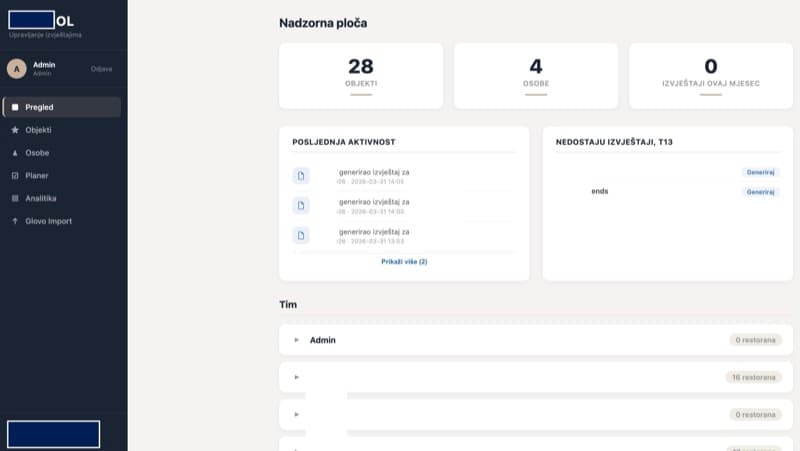
For an agency that runs delivery platforms for restaurants, the system takes in the platform reports on its own every month, joins them per venue and assembles the report that goes to the client. Work that used to mean several days of assembling spreadsheets is now an import and a check, and every figure in the report traces back to its source row. Different fields, the same principle: the machine does the repetitive part, and people keep control over the decisions.
How a project runs
AI projects most often fail when they start too broad. So we start the other way round: we pick one process, build a small pilot and measure the result on real data. If the pilot does not save time or money, you find out after a few weeks, not after a six-month project.
When the pilot proves its value, we expand it into a production system: connections to your tools, error handling, monitoring and a clearly defined point where a person checks the result.
Where the automation runs
Automation rarely has a screen of its own. It works inside a system you already use or one we build together with it, for example in a webshop's admin panel or in a business system. If you still need that system, see web application development and mobile app development.
Every automation that depends on an outside system gets a daily check. The check tests the connection and sends an alert only when it cannot recover by itself, because an error in that kind of flow would otherwise show up only at the end of the month.
Models and tooling
We work with models accessed through an API, mainly Claude and OpenAI's models. That means you need neither your own model nor expensive infrastructure: you pay for usage, and the system uses your data as context instead of being trained on it. We build the integrations in the same stack as the rest of the software, so the AI part does not stand apart from the rest of the system.
Where AI is not the answer
Part of a process does not need AI but ordinary software: if a problem is solved by a formula, a database or a good form, that is cheaper and more reliable. Other problems need a person, and there we keep AI in the role of an assistant. We will tell you openly which category your process falls into, even when the answer means a smaller project for us.
From the portfolio
AI in systems we have built.

Web platform
VisitStaxo News
A daily crypto digest in five languages. Each morning an AI reads dozens of sources, picks the stories that actually moved something and rewrites them in plain language, without jargon or hype. Subscribers get the summary in their inbox and know where the market stands in a few minutes.
Business system
VisitAgency CRM
CRM for a consultancy working with restaurants and food brands. Tracks clients and their venues, consolidates data from delivery platforms, and produces reports, a planner and analytics.
CRM for agencies and service businesses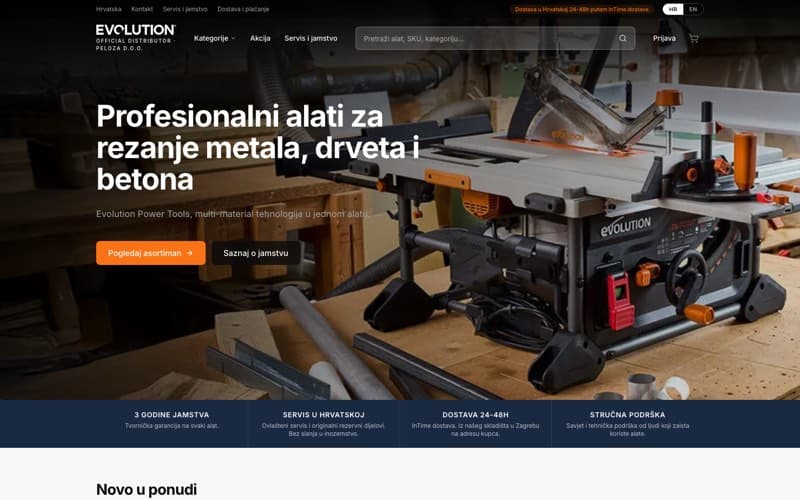
Webshop
VisitEvolution Power Tools
The official Croatian webshop for Evolution Power Tools. Bilingual catalogue with search and product variants, Stripe checkout, shipping priced by weight and zone, and an admin panel for products, orders, promotions and enquiries.
Read the case studyQuestions
FAQ
Which tasks are usually automated first?+
The ones done every month and always the same way, because that is where the saving shows immediately, for example processing incoming documents and monthly reports. Tasks done twice a year we leave to people, because automating them costs more than it brings.
How much does an AI pilot cost?+
We keep the pilot small on purpose: one process, real data and a measurable result. The price depends on the number and format of the sources the system reads and on the systems it writes the result into. Describe the process in the enquiry form, and you get the scope and price in writing after the first call, at no charge. You decide on expanding it based on the measured effect.
How long does a pilot take?+
A few weeks. That is enough for the system to process real data from your business and for us to measure how much time or money it saves. If it does not save any, you know after the pilot, not after a six-month project.
What happens to our data?+
The data is sent to the model as context for processing and is not used for training. We limit, by contract and technically, what leaves your system, and we mask sensitive data before sending whenever possible.
Do we need our own model?+
As a rule, no. Models such as Claude and OpenAI's are used through an API and paid for by usage, and your data serves as context. Your own model only makes sense in very specific cases with large volumes.
What happens when the AI gets it wrong?+
We plan for it from day one. We design the system so results are validated: automatic checks where possible, and a person confirms decisions that have consequences. We do not let AI run unsupervised on processes where a mistake is costly.
Can a chatbot answer only from our documentation?+
Yes, and that is how we build it. The chatbot gets your documentation as its source and answers from it, and every answer is linked to the part of the documentation it came from, so it can be checked. When the answer is not in the documentation, the chatbot says so instead of making one up.
Does the AI work in Croatian?+
Yes. The models we use read and write Croatian and can translate. On the Evolution Power Tools webshop, product descriptions are translated from Croatian to English automatically, and translations that someone has corrected by hand are left untouched by the system.
What does automation mean for the people who do this work today?+
Their work shifts from retyping to checking. In the agency system from the example above, people now check the report before it goes to the client, instead of assembling it from spreadsheets. That is why we build automation together with the people who do the process today, because they know where the exceptions are.
What if our data is messy?+
It is rarely tidy, and we plan for that. Data from different sources arrives in different formats and with different names for the same thing, so joining and cleaning it is part of the pilot. In the agency system, the same venue arrives under different names from different platforms, and the system recognises and joins it before it assembles the report.
How do we know the automation paid off?+
By the number we measure before the pilot. We compare how long the work takes today and how long it takes with automation, on the same real data, together with the number of corrections a person has to make. If the difference does not cover the cost, we will recommend not expanding it.
Do you work with clients outside Croatia?+
Yes. We are based in Zagreb and build software for clients in Croatia and abroad. We invoice as a Croatian company with an EU VAT number.
Contact
Have an idea? Let's talk.
Tell us about the project. We reply within 24 hours. We write the scope and the estimate, after a first call and at no charge.
Software development
Need the system first?
Custom CRM and business systems: records, invoices and reports instead of Excel spreadsheets.
Custom CRM developmentSoftware development
Need a mobile app?
Flutter applications for iOS and Android from one codebase, from idea to store release.
Mobile app development