
Software development
Mobile app development for iOS and Android.
Both apps come from one codebase, in Flutter. We handle the whole process: design, development, backend, store release and the versions that come after.
We reply within 24 hours.
Based in Zagreb, EU VAT registered, working with international clients.
When you need a mobile app
A mobile app makes sense when users open it several times a day and on the move, or when the app itself is the product you sell through the App Store and Google Play. Staxo, our app for learning to trade, is that kind of product: it is sold through the App Store and Google Play as a subscription.
If the system is opened at a desk or a few times a week, a web application is often enough and cheaper. Patrono started exactly that way: staff opened the shift schedule and checklists on their phones in the browser, and the app on the App Store and Google Play came later. If that is your case, see web application development.
Why Flutter
You can build a mobile app twice, once for iOS and once for Android, or once in Flutter. From one codebase Flutter produces the app for both platforms, with a look and speed that users cannot tell apart from a native app.
For you that means concrete things: development costs less than two separate apps, a new feature reaches both platforms at the same time, and a bug is fixed once. We also built our own app in Flutter, which is live on the App Store and Google Play today, so we know the tool from production, not from demo projects.
Design before development
We design the interface and user experience in house, and for brand and visual identity we have a partnership with Spiffy Studio. For a new idea we can first make a clickable prototype that you try on your phone, so the idea is tested before development even starts. You approve the screens, and only then does programming begin.
What the app gets
Besides the screens themselves, a mobile app almost always needs infrastructure around it. We set that up as part of the project:
- User sign-in: email, Google or Apple account, and biometrics where needed.
- A backend and a database that sync in real time.
- Push notifications that bring users back to the app.
- Subscription billing through the App Store and Google Play.
- Crash reporting and analytics, so problems are visible before users report them.
From idea to release
The project starts with a conversation about what the app does and for whom, and continues with screen designs that you approve before development starts. During development you try the app on your own phone through test builds, so feedback goes in before release, not after bad reviews.
We handle the release: developer accounts, store descriptions and screenshots, and getting through Apple's and Google's review. The app is released when users can download it, and only then do we consider the project delivered.
What we have built
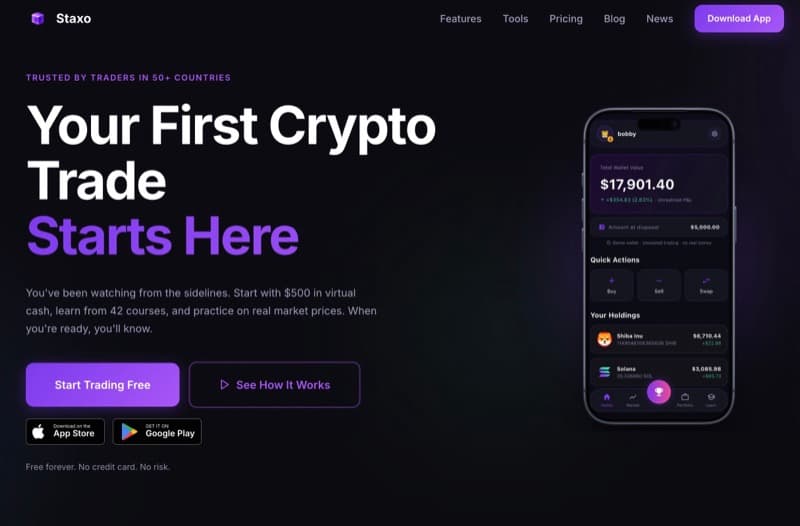
Staxo is our mobile app for learning to trade cryptocurrencies, with a virtual portfolio and real market prices. It is built in Flutter with a Firebase backend, a database that syncs in real time and push notifications. Prices arrive over a persistent connection to the server, and subscriptions are billed through the App Store and Google Play. Alongside trading it has courses with quizzes, levels, leagues and leaderboards, so users have a reason to come back. The app gets new versions regularly, with updates for new versions of iOS and Android. Read how we built Staxo.
Patrono and Klinika Hub run in the browser and as apps on iOS and Android, from the same data, so the same information is there at the desk and on the phone. The Patrono app is published on the App Store and Google Play.
After release
The stores change: a new iOS comes out every autumn, Google regularly raises its technical requirements, and an app that is not maintained sooner or later stops passing review. Under a maintenance contract we track those changes, release new versions and add features as the product grows.
From the portfolio
A mobile app from our portfolio.
Mobile app
VisitStaxo
Crypto trading simulator for iOS and Android. A virtual portfolio priced off the real market, so people learn to trade without risking their own money. Courses with quizzes, XP and levels, leagues and leaderboards, and a full history of every trade.
Read the case studyQuestions
FAQ
How much does mobile app development cost?+
The price depends on the screens and user roles, the backend the app needs, subscription billing and connections to other systems. Flutter lowers it, because there are not two separate apps to develop for iOS and Android. Describe the idea in the enquiry form, and you get a written proposal with price and timeline after the first call, at no charge.
How long does mobile app development take?+
An app with user accounts usually takes two to four months of development. Apple's and Google's review has to be added to that, and since they review every version from scratch, we plan it into the timeline. We agree the exact timeline once we know the scope, not before.
Is a Flutter app different from a native app?+
Users do not see a difference. Flutter draws the interface itself, so the app looks and responds like a native app on both systems, and biometrics and push notifications work through the same interfaces native apps use. The difference is on your side: one development effort and one maintenance effort instead of two.
Does the app need a backend?+
Almost always. User sign-in, data sync and push notifications need a server. We build the backend as part of the project, usually on Firebase or on a custom API, depending on what the app needs.
Can we get a web version alongside the mobile app later?+
Yes. We build the backend as a separate part, so a web version later reads the same data and follows the same rules, without a second database. Patrono and Klinika Hub work this way: the same user opens them in the browser at a desk and as an app on the phone. Patrono is on the App Store and Google Play.
Can we try the app before release?+
Yes, on your own phone, through test builds we send during development. That way feedback goes into the app before release. You approve the screens even earlier, at the design stage, before development starts.
Who submits the app to the stores?+
We do. We set up the developer accounts, prepare the descriptions and screenshots, and take the app through Apple's and Google's review. The accounts and the app are in your name and remain your property.
What if Apple or Google rejects the app?+
We fix what the reviewer asks for and submit a new version. Most rejections are resolved by making sure the reviewer sees what they need to see, which is why we keep a demo account ready for every release. Approval of one version does not carry over to the next, so we plan review time for each one.
How is a subscription charged in a mobile app?+
Through the App Store and Google Play. Users pay with the account they already have on their phone, and the store handles billing and renewals. We connect subscription status to the backend, so the app always knows who has access to the paid part. Staxo works this way, with a free and a paid tier.
How will we know whether the app is being used?+
We set up analytics and crash reporting before release. You see how many users come back and where they drop off. Crashes reach us before users report them, with the device and the version where they happened.
Does the app need maintenance even when we add nothing new?+
Yes. Apple releases a new iOS every autumn and Google regularly raises the technical requirements for publishing, so an app that is not maintained sooner or later fails review even for a small fix. Maintenance tracks those changes and releases versions on time, and new features are built by agreement.
Do you work with clients outside Croatia?+
Yes. We are based in Zagreb and build software for clients in Croatia and abroad. We invoice as a Croatian company with an EU VAT number.
Contact
Have an idea? Let's talk.
Tell us about the project. We reply within 24 hours. We write the scope and the estimate, after a first call and at no charge.
Software development
Need a web application too?
SaaS platforms, webshops and dashboards in Next.js and React, from idea to production.
Web application developmentSoftware development
Interested in AI in your product?
AI integrations and process automation: chatbots, document processing, data pipelines.
AI automation